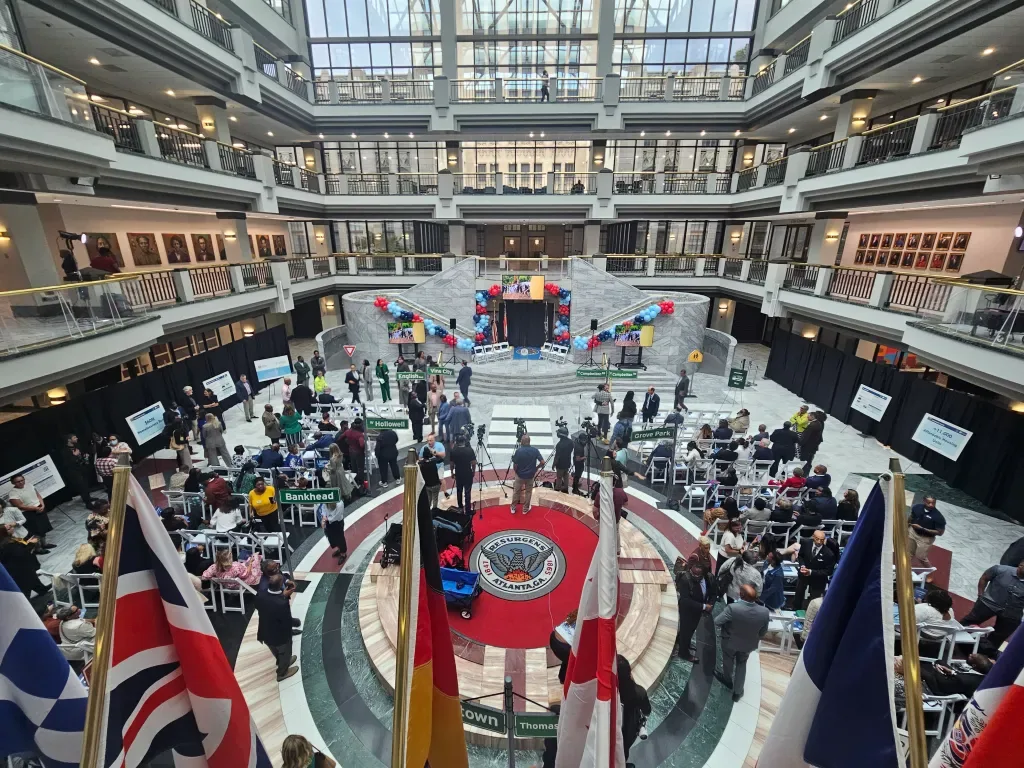
Mayor Andre Dickens is making the biggest funding bet of his term on a tool that has driven the past 20 years of Atlanta redevelopment: tax allocation districts. Atlanta Civic Circle reports that Councilmember Michael Julian Bond last week introduced legislation from the Dickens administration to extend the lifetimes of six of the city's eight active TADs through 2056. If the City Council, Fulton County, and Atlanta Public Schools all sign off, the city would keep capturing future property-tax growth in the Westside, Eastside, Campbellton Road, Donald Lee Hollowell Parkway/MLK Jr. Drive, Metropolitan Parkway, and Stadium TADs for another three decades.
The scale of what that math could produce is what makes this a story. Courtney English, the mayor's chief of staff, told Atlanta Civic Circle the six TADs could generate between $5 billion and $7 billion for the Neighborhood Reinvestment Initiative over the next 30 years, assuming five percent annual growth in property values. That is the number Dickens has been citing publicly as the size of the NRI itself.
The catch is built into the tool. TAD dollars can only be spent inside the TAD they were collected in, and the Neighborhood Reinvestment Initiative is explicitly designed to reach neighborhoods that are not inside any TAD. Public finance experts and city officials told ACC that the city will need additional public funding sources beyond the tax increment revenue. For ITP residents the practical question is which neighborhoods get the TAD money first, which depend on supplemental sources, and whether the Council moves the extensions before the World Cup and the next budget cycle force the issue. The Stadium TAD wraps Summerhill, Peoplestown, and Mechanicsville. The Eastside TAD covers Old Fourth Ward and chunks of downtown. The Westside TAD pulls in West End and the Westside generally. Whichever combination of TADs gets extended sets the next 30 years of neighborhood-level capital spending.