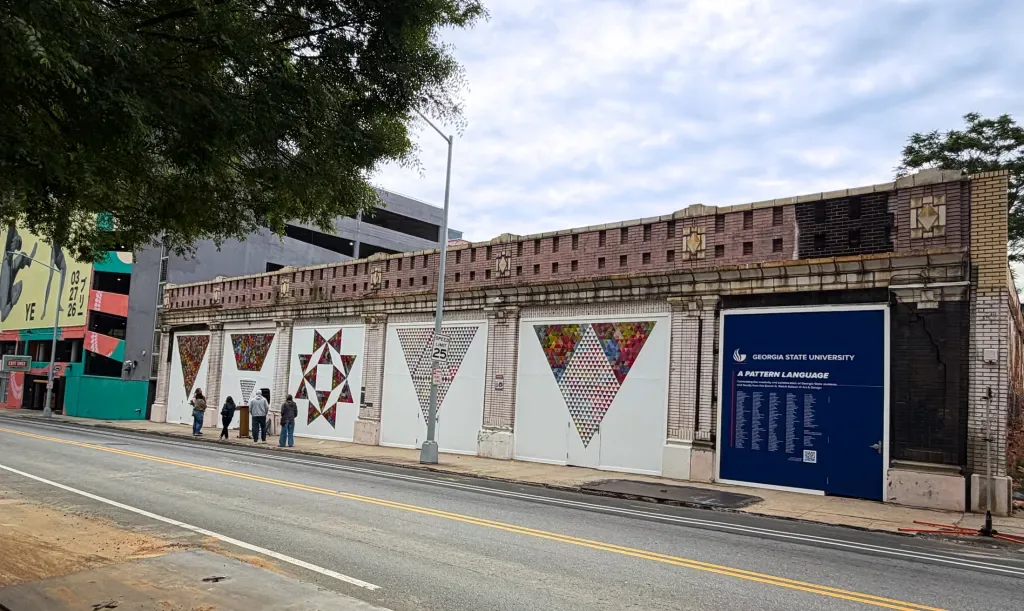
South Downtown is getting a coat of paint, and the paintbrushes belong to Georgia State students. SaportaReport detailed how the GSU Two-Dimensional Design class mural project, which started under the Courtland Street viaduct on the downtown campus, has expanded into South Downtown walls just in time for the FIFA World Cup foot traffic. Nearly 200 students contributed motifs that the class arranged collaboratively into the larger panels going up on the new walls.
The original campus mural, the one student Laura Hayes walked past every day last fall before joining the project this semester, set the template. Each class period of Two-Dimensional Design treats the mural as a single collaborative composition. Students bring individual motifs, the class arranges them into a larger panel, and the panel gets installed under the viaduct as part of the running campus piece. The pedagogical bet is that the work feels different when the students know it is going on a wall in public, not into a sketchbook for a grade.
The South Downtown expansion is the part that lands in time for the World Cup. May 2, Georgia State and the developers behind the South Downtown redevelopment unveiled the next wave of student-designed panels going up across the district's surface lots and underpasses. The timing is deliberate. The World Cup matches in Atlanta this summer will pull tens of thousands of visitors through South Downtown on foot, particularly the corridor that connects the Mercedes-Benz Stadium and State Farm Arena complex with the Georgia State campus and the southern edge of the central business district. Blank walls are the first thing visitors notice. Murals are the second.
The practical effect for Atlantans is straightforward. South Downtown has spent years as the part of the central city most likely to look like the part that the redevelopment money skipped. The student mural project, taken together with the broader South Downtown adaptive-reuse work, is reshaping the walking environment for the World Cup window and for the years after. SaportaReport's piece, part of the Georgia State University thought-leadership column, frames the project as both a teaching exercise and a public art investment with a real audience. The students who walked past the original viaduct mural last fall are now the ones putting their work in front of the world.